Showing posts with label Article Review. Show all posts

Wednesday, October 9, 2024

Review of "Effect of Supply Chain Integration on the Ppuri Industry"


Abstract

This is a review of “The Effect of Supply Chain Integration on Supply Chain Risk Management Capability and Firm Performance in the Ppuri Industry” (Jung et al, 2022). The background concepts as well as the relevant concepts from supply chain management necessary to explain this research are defined. The research model they study is described, a research model they are unable to verify. Some of the reasons the authors give for this failure are listed. The managerial applications (or lack thereof) are described. We conclude with comments about the follow-up research they expect to conduct.


Authors’ Purpose

The ppuri industry is a niche industry in South Korea (Dongki, 2021) involved in creating or finishing metal parts used in the making of automobiles, industrial machinery, household appliances, etc. The ppuri industry is also in trouble: ppuri companies have not expanded in any significant manner in recent times, and in fact many of the companies investigated by the authors in this paper went out of business during their research. The authors attempt to explain this by looking at the operation of the supply chain of ppuri companies. They examine the relationship between supply chain integration, supply chain risk management capability, and firm performance. The expected relationships do not hold, and the authors interpret why this happens.


Summary of the Article and its Context

This paper is a study of the ppuri industry in South Korea, an industry that produces or finishes metal parts for large manufacturers. The industry has been struggling in recent years, and the authors attempt to understand the cause of this in terms of supply chain operation. In their study, they find that the relation between supply chain integration and firm performance is not what the authors expected.

They admit that their study suffered from some problems (it used a small sample size and was conducted during COVID-19) but are unable to explain this counterintuitive situation. They make some observations about the conditions in the ppuri industry that may explain this, the most striking one involves the significant difference in size between ppuri companies and the manufacturers they supply. They leave this investigation for future research.


Background of the Issue

The ppuri industry, also called the "root industry," in South Korea is the industry of making metal parts using casting, molding, plastic working, and welding, or finishing those parts using heat or surface treatment (Jung et al, 2022, p. 32-33). These parts are then assembled by manufacturers into automobiles, appliances, industrial or restaurant equipment, etc. (Dongki, 2021). It is called "root" because those parts are of fundamental importance to the manufacturers, and that the parts find their way into many industrial and consumer products.

The ppuri industry has been struggling as illustrated by the facts that ppuri companies are small companies that remain small, that companies have difficulties in finding employees, and that the companies are unable to be competitive due to lack of R&D activities. A South Korea-Japan trade dispute in July 2019 only intensified these problems (Yung et al, 2022, p. 33).

Attempts have been made to strengthen the competitiveness of this industry using strategies that involve increasing supply chain integration. It is expected that tightening SC integration would improve the performance of ppuri companies. But does it?

The authors attempt to investigate the relationship between supply chain integration, the capacity to manage supply chain risk, and overall firm performance. They do this by surveying managers working in ppuri companies and arrive at some counterintuitive observations.


Application of Relevant Supply Chain Management Theory

Modern supply chain management (SCM) has long recognized the fundamental importance of supply chains in company operation, and SC managers understand how well-run supply chains can add value to the products that customers purchase. Because of this, risks to the supply chain must be well understood.

A supply chain risk (Son, 2018, p. 2296-2297) is any event that diminishes the operation of the supply chain. These risks can include buyer-related risks (distortion of demand information or demand volatility), supplier-related risks (poor raw material quality or supplier bankruptcy). Finally, there are internal-process risks such as change in production costs. Supply chain risk management (SCRM) (Son, 2018, p. 2297-2300) are the steps needed to reduce risks or vulnerabilities to the supply chain.

Supply chain integration, one of the holy grails of contemporary supply chain management (Quigg, 2022, p. 24-52), is the degree of cooperation within and between participating organizations. The authors classify integration as being internal or external, and external integration is further broken down into supplier integration and buyer integration.

Supplier integration is an organization’s ability to develop, maintain, and manage long-term relationships with suppliers (Jung, 2022, p. 35). Buyer integration is the practice of managing customer relationships and improving overall customer satisfaction.

External integration allows for cost reduction, productivity and agility improvements, and ease of obtaining resources (Quigg, 2022, p. 373). It also improves operational performance measured by quality, cost, delivery, and flexibility. This improved operational performance should eventually lead to increased company performance (Jung, 2022, p. 35).

In contrast, internal integration are organizational practices that encourage various departments to share knowledge (Jung, 2022, p. 35-36). This knowledge supports external integration and allows the company to achieve company goals. It also allows sharing and cooperation among departments thereby reducing conflict and promoting corporate stability.


Managerial Implications of Article Findings

Based off all this, the authors propose the following hypotheses about the relationships between the above types of integration and overall company performance:

H1a: Supplier integration improves firm performance.
H1b: Buyer integration improves firm performance.
H1c: Internal integration improves firm performance.

Internal integration also makes the supply chain more agile, enabling faster and more effective responses to environmental changes. Further, it also improves the company’s ability to identify internal risks in the supply chain. Integration is thus expected to improve SCRM capability, and the following hypotheses are posited by the authors:

H2a: Supplier integration improves SCRM capability.
H2b: Buyer integration improves SCRM capability.
H2c: Internal integration improves SCRM capability.

Finally, improvement of SCRM capability should have a positive impact on corporate performance, so the authors propose one final hypothesis:

H3: SCRM capability improves firm performance.

Combining these hypotheses together generates a research model where each of the three types of integration (supplier, buyer, and internal) positively bolster firm performance and SCRM capability, and that SCRM capability improves firm performance.

Research Model from (Jung et al, 2022)

The authors are unable to verify this research model, however common-sensical it may seem. In particular, supply chain integration does not improve firm performance, at least when it comes to supplier and buyer integration. Supplier and internal supply chain integration were shown to have a positive impact on SCRM capability, but buyer integration was not. Finally, SCRM capability was shown to positively impact firm performance.

The authors were thus unable to verify three of the seven hypotheses stipulated above. In summary:

H1a: Supplier integration → firm performance – not supported.
H1b: Buyer integration → firm performance – not supported.
H1c: Internal integration → firm performance – supported.
H2a: Supplier integration → SCRM capability – supported.
H2b: Buyer integration → SCRM capability – not supported.
H2c: Internal integration → SCRM capability – supported.
H3: SCRM capability → firm performance – supported.

How can this be explained? The authors specifically note that their study may suffer from a small sample size: surveys were sent to 928 ppuri companies, seventy-five responded, but one was rejected because it was incomplete. The authors used the remaining seventy-four responses as the base of this study. They also state that many of the unreturned responses were caused by the ppuri companies going out of business.

Another flaw in their study noted by the authors is that it was conducted during the COVID-19 plague. They did not investigate how the plague specifically hampered their investigation.

The authors do propose an explanation for the unexpected relationships between supply chain integration, firm performance, and SCRM capability:

Firms in the Ppuri industry play a role as suppliers of large companies in the supply chain, and most of them perform simple manufacturing and processing tasks at the request of buying companies. Therefore, even if the level of buyer integration increases, firms in the Ppuri industry might not fully achieve the advantages of buyer integration, including cost reduction, productivity improvement, and ease of securing resources, due to the power imbalance between supply chain partners. (Jung et al, 2022, p. 43)

In other words, the great difference in size between ppuri companies and the manufacturers they supply somehow explains the lack of expected relationships. They do not investigate this explanation, either statistically or through deductive logic. If they do investigate it in a future paper, they should check to see if a similar phenomenon occurs in other situations where this “power imbalance” is in effect.

The authors recommend that ppuri companies do take steps needed to integrate suppliers and buyers into their supply chain, and they expect that this will improve SCRM capability and firm performance. These recommendations are not borne out in this paper, and verifying their recommendations would require A/B testing.

Because of the quality of the research and the very niche nature of the ppuri industry, implementing their unproven recommendations in another industry is justified only because having an integrated supply chain makes sense.


Conclusion

The authors have established that supply chain integration doesn’t necessarily improve supply chain risk management capabilities nor firm performance. Because of the counterintuitive nature of that statement – as well as problems executing this study – further research is certainly needed.


References

Bax, J. & Ruel, S. (2021). “Can supply chain risk management practices mitigate the disruption impacts on supply chains’ resilience and robustness? Evidence from an empirical survey in a COVID-19 outbreak era.” International journal of production economics, 233, 107972. https://doi.org/10.1016/j.ijpe.2020.107972

Dongki, L. (2021). “What is PPURI industry?” Korea National PPURI Industry Center. Retrieved 8 October 2021 from https://www.techconnect.kr/html/?pmode=UserAddon&smode=ajax&fn=ViewFile&fileSeq=6724

Jung, J., Shin, J., & Yang, H. (2022). “The effect of supply chain integration on supply chain risk management capability and firm performance in the ppuri industry.” Seoul Journal of Business, 28 (2), 31-48. https://doi.org/10.35152/snusjb.2022.28.2.002

Quigg, B. (2022). Supply Chain Management (1st ed). McGraw-Hill Create. https://bookshelf.vitalsource.com/books/9781307866025

Son, C. (2018). “Supply chain risk management: A review of thirteen years of research.” American Journal of Industrial and Business Management, 8 (12), 2294-2320. https://10.4236/ajibm.2018.812154

Monday, September 30, 2024

Review of "SCM and Business Strategy"

Abstract

In this review of “Supply chain management: Some reflections to improve its influence in business strategy” (Arrendondo & Alfaro Tanco, 2021) we briefly recount the history of operations management and supply chain management provided therein. We then examine some ways supply chain management (specifically, outsourcing and quality control) are relevant. Next, the qualifications Arrendondo and Alfaro Tanco list as the job requirements of supply chain managers are examined. Finally the organizational structure they recommend is criticized.


Article Summary

In “Supply chain management: Some reflections to improve its influence in business strategy”, Arredondo and Alfaro Tanco trace the evolution of the discipline of supply chain management (SCM) starting from its beginnings in operations management (OM) all the way to SCM as a business management philosophy. In recounting this history, the authors attempt to isolate when SCM became independent of OM.

In doing this they briefly examine the relationship between logistics and SCM, and propose four perspectives for looking at this relationship: traditionalist (SCM is part of logistics), re-labeling (SCM replaces logistics), unionist (logistics is part of SCM), and intersectional (SCM and logistics are related and share certain aspects). They assert that the intersectional perspective is the correct way of viewing this relationship and leads to SCM being of strategic importance to a business. They claim that SCM strategy is a crucial part of business strategy or that they may even be identical.

Because of the importance of SCM to a business, supply chain managers play a particularly vital role in the business. The authors describe what SC managers should do in order to make multi-partner supply chains work. The paper concludes with a description of the personality SC managers should have in order to make this happen, and the business organization that best allows SCM to provide value to a company.


Authors’ Purpose

Arredondo and Alfaro Tanco claim that supply chain management (SCM) plays a pivotal and underappreciated role in business operations. To prove this, they cover the history of operations management (OM) starting from before the industrial revolution up to today, focusing on how SCM emerged as an independent field from OM. Unlike Bayraktar et al (2007), they approach this from a pure business perspective. They also discuss how SCM differentiated itself as an academic discipline from logistics, and caution that equating SCM with logistics weakens the strategic advantages that good SCM can bring to a company. They conclude with a discussion of the characteristics that supply chain managers should possess as well as the ideal organization a company should have in order to benefit the most from good SCM.


Historical Background

Evolution of Operations Management
From Arredondo & Alfaro Tanco (2021)

The authors begin their history of operations management (OM) by claiming that prior to the middle of the 1500s, production was limited to mining, agriculture, and livestock. This changed in 1556 with Georgius Agricola’s “De re metallica” which detailed the processes of mining, refining, and smelting metals. The authors consider this to be the first OM textbook. Fast forward to the industrial revolution, where factory management was the primary concern of business owners.

This changed with Frederick Taylor’s publication of “The Principles of Scientific Management,” where attention shifted from machinery to work and began the phase of industrial management – as well as worker micromanagement. This period included Henry Ford’s moving assembly line.

With the start of World War II, industrial management was replaced by production management. Production management continued to be the predominant theory of business management until it was replaced by operations management and operations research, which was initiated in the late 1950s by a series of academic papers by Holt, Modigliani, Muth, and Simon (HMMS). These papers focused on production planning and forecasting (Singhal & Singhai, 2006) and involved what is today called discrete mathematics.

Operations research gave operations management a theoretical bent, and industrial engineers moved from engineering schools to business schools. OM theorists produced system-wide studies. Material resource planning (MRP) and enterprise resource planning (ERP) became important. Innovative approaches to OM came from Japan where MRP (a push system) was replaced by JIT, which used a pull system. (Arredondo & Alfaro Tanco, 2021, p. 10).

By the 1990s, theoretical OR started to be replaced by empirical studies involving direct observations of business processes. Operations management was still the predominant business management philosophy. The authors end their discussion of OM history there.

When and how did SCM emerge from OM? The authors trace the start of SCM to the HMMS works, noting how they studied integrated systems of managing production. The emergence of SCM was triggered sometime between 1980 and 1990 by the recognition of the importance of the extended supply chain, and that a holistic approach to various management systems – including organizational structure, planning, management control, communications and information, and evaluations and rewards – was needed. Logistics was also extended to issues such as inventories, supply, and distribution.

SCM thus grew to include OM as well as other business concerns (Arredondo & Alfaro Tanco, 2021, p. 13) including finance, marketing, purchasing, research and development, and IT. All this is codified in the 1994 definition of supply chain management supplied by the International Center for Competitive Excellence: “Supply chain management is the integration of business processes from end user through original suppliers that provides products, services and information that add value for customers.”

The strategic importance of SCM doesn’t lie in business operation or in logistics. SCM is really about value chains or value networks, the authors claim.


Application of Relevant SCM Theory

Producing quality goods and services is certainly desirable and becomes particularly important with businesses using the extended supply chain because of the tight integration of customers into SCM. The extended supply chain can both increase and threaten quality (especially product and design quality). Because a business outsources the production of component parts, the quality of those parts is no longer in control of the business. Compensating for this is the possibility of outsourcing the production of component parts to multiple suppliers – if one supplier delivers substandard components, another supplier can be used. This also allows for competition amongst the suppliers.

The production of quality goods is crucial for maintaining customer satisfaction, customer loyalty, and brand reputation. When faulty or substandard products reach the customer, the business incurs external failure costs from product returns, complaint settlements, repairs. (Quigg, 2022, p. 306, 337-338)

Even before reaching the customer, though, the business bears costs related to quality control. Internal failure costs (Quigg, 2022, p. 337) result from having to scrap, salvage, or rework products found to be defective. Determining whether a product is indeed defective entails appraisal costs. Prevention costs (Quigg, 2022, p. 337) are incurred when low quality parts require finding another supplier or even redesigning the product to compensate for the low-quality component parts. (Quigg, 2022, p. 306 – 307).

The ultimate solution to quality control problems is total quality management (TQM). TQM requires a cultural change not only within a business but extends to suppliers and other supply chain partners (Quigg, 2022, p. 340). By the end of this change, businesses should be involved in continuous improvement (Quigg, 2022, p. 340 – 341) as well as statistical analysis of defects (Quigg, 2022, p. 342 – 346).


Managerial Implications

The paper is quite explicit about the characteristics a good supply chain manager should have and the role he or she should play within a company. It also makes some specific recommendations about company organization.

Given the central role that SCM should play in business strategy, SC managers should be given significant roles in business operations. The SC manager is described as the nexus between the business and the stakeholders, and the authors describe the SC manager’s role as akin to the conductor of an orchestra. Overall, the SC manager is “the enabler that makes things happen.” (Arredondo & Alfaro Tanco, 2021, p. 16)

As such, SC managers should hold a staff position within the organization and should have "soft skills instead of hard ones." (Arredondo & Alfaro Tanco, 2021, p. 15). According to this paper, an SC manager should have human management skills plus a holistic view of the entire business, in other words a “systems” view. Technical skills are made secondary. These soft skills should include multicultural knowledge, change management, conflict resolution, interpersonal and communication skills, and ethical awareness. (Arredondo & Alfaro Tanco, 2021, p. 15)

SC managers should be cross-functional, process-oriented, and be included in managing interactions with customers and suppliers. Again, hard skills are not required.

Specific notes are also made about the ideal organization of the company: instead of a functional organization, a matrix-like structure that allows specific skills to flow between teams, thus eliminating “silos.” Not mentioned, however, is that employees in matrix-like structures have more than one manager. The overall business organization should focus on meeting customers’ requirements. The authors recommend “mandatory coordination” (Arredondo & Alfaro Tanco, 2021, p. 16) to make all this happen. This has implications for compensations and incentives as well.

The authors do not specify how the SC manager should fit within this matrix organization. Given the emphasis placed on soft skills, multicultural knowledge, conflict resolution, etc., it is not clear how much responsibility and accountability should be expected from SC managers.

Working across multiple companies – as is stipulated by modern SCM practices – entails a “power differential”: one company would have more “power” over another. This requires not only cooperation and a certain level of trust. The authors believe that a fundamental sense of partnership should be in place. This is the authors’ primary motivation for requiring all the above-listed soft skills.


Conclusion

The authors’ purpose is to highlight the strategic importance of supply chain management in contemporary businesses. They do this by explaining the history of operations management and how SCM evolved from that. They claim that SCM is not about logistics but rater value chains. The argument for the strategic importance of SCM is weakened, however, by the overly-broad conception of that they use: according to them, SCM should encompass all operational aspects of business operation.


References

Arredondo, C. & Alfaro Tanco, J. (2021). “Supply chain management: Some reflections to improve its influence in business strategy.” Innovar 31(81), 7-20. https://doi.org/10.15446/innovar.v31n81.95568

Bayraktar, E., Jothishankar, M., Tatoglu, E. & We, T. (2007). “Evolution of operations management: past, present and future.” Management Research News, ISSN: 0140-9174

Quigg, B. (2022). Supply Chain Management (1st ed). McGraw-Hill Create. https://bookshelf.vitalsource.com/books/9781307866025

Singhal, J. & Singhai, K. (2006). “Holt, Modigliani, Muth, and Simon's work and its role in the renaissance and evolution of operations management.” Journal of Operations Management 25(2), 300-309. https://doi.org/10.1016/j.jom.2006.06.003

Monday, September 23, 2024

Review of “The Impact of SCM Practices on Supply Chain Agility"


Abstract

In this review of Saa’da et al's 2022 paper “The impact of supply chain management practices on supply chain agility – Empirical study in medical sector”, we define the fundamental concepts used in their paper. Next, we examine some of the ways supply chain management theory is relevant to this topic, focusing on the concepts of postponement and make-to-order production. After that, the managerial applications of that paper are examined. The hypotheses that the authors use to validate their conceptual model are listed, and their most interesting finding is stated. Finally, a problem in their conceptual model is indicated.


Summary of the Paper

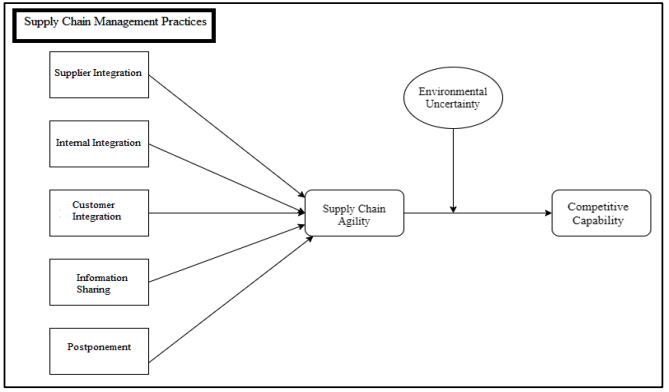
Saa’da et al (2022) examines the impact that five supply chain management practices – supplier integration, internal integration, customer integration, information sharing, and postponement - have on a company’s competitive capability, and how that capability influences supply chain agility. Their research is done by analyzing survey responses from 315 employees in Jordan’s medical sector.

The authors investigate the relationship between certain supply chain management (SCM) practices, competitive capability, and supply chain agility. They attempt to demonstrate that the SCM practices being investigated significantly benefit supply chain performance. They show that three types of supply chain integration (supplier, internal, and consumer) is moderated by competitive strength. Supply chain efficiency (or “effectiveness efficiency” as they call it) is caused by internal integration, customer integration, and postponement, but supplier integration and information sharing do not positively impact supply chain effectiveness. Finally, information sharing, customer integration, and supply chain efficiency is moderated by competitive capability.

In order to do all this, they evaluate and confirm the following hypotheses:

H1 Supply Chain Management Practices are positively related to Competitive Capability.
H1a Supplier Integration is positively related to Competitive Capability.
H1b Internal Integration is positively related to Competitive Capability.
H1c Customer Integration is positively related to Competitive Capability.
H1d Information Sharing is positively related to Competitive Capability.
H1e Postponement is positively related to Competitive Capability.
H2 Competitive Capability is positively related to Supply Chain Agility.
H3 Environmental Uncertainty mediates the relationship between Competitive Capability and Supply Chain Agility. (Saa’da et al, 2002, pp. 6-7)

From this, they validate a conceptual model where the five SCM practices positively impact competitive capability, where competitive capability positively impacts supply chain agility, and where environmental uncertainty mediates the relationship between competitive capability and supply chain agility.

Conceptual Model of SCM Practices
Figure 1 from Saa’da et al, 2022. - maybe needs correction?

There are several interesting findings, the most important being that consumer integration and knowledge exchange have an outsized benefit to competitive capability. (Saa’da et al, 2022, p. 12). As such, visibility into supply chain integration results not only in increased competitive capability but also improved supply chain agility.


Background

To understand this paper, it is necessary to define the terms being used: supplier integration, internal integration, customer integration, information sharing, postponement, supply chain agility, competitive capability, and environmental uncertainty.

Supplier integration is an SCM strategy that involves a company collaborating with its suppliers to improve the flow of data and communication between them. This gives the company visibility into the ability of the supplier to fulfill orders, and it gives the supplier insight into the company’s expected demands.

Internal integration, also called horizontal integration, is the process of connecting different departments within a company. This allows for collaboration and results in the elimination of duplicative efforts and “silos.”

Customer integration is the process of involving customers into the supply chain for purposes of gathering quality information, helping the company to better understand customer preferences.

Information sharing is the “comprehensive incorporation of all business procedures within and outside the organization so as to enable the exchange of information, as well as movement of products, money, and services” (Saa’da et al, 2022, p. 4). This allows stakeholders to view the entire business, not just the supply chain.

Postponement is a "deliberate action through which the final manufacturing or distribution of products or services are delayed until the receipt of customer’s order" (Saa’da et al, 2022, p. 4). This reduces risk by preventing wrong manufacturing or incorrect inventory deployment (Saa’da et al, 2022, pp. 4-5). Postponement, if not already in place, can involve significant reconfiguration of the supply chain, but can be considered valuable in some circumstances (Van Hoek et al, 1998, pp. 33-35).

Supply chain agility is the capability of a company to effectively respond rapidly to changes in consumer demand as well as market changes.

Competitive capability is a company’s ability to satisfy customer expectations relative to its competitors.

Environmental uncertainty is the degree of unpredictability of a company’s external environment relevant to that company’s operations. The causes of environmental uncertainties include unpredictable actions by competitors, changing customer preferences, and technological advancements.


Application of Relevant Supply Chain Management Theory

The authors discuss postponement as a supply chain management principle and present it as an unlimited good. Postponement is a strategy where certain final decisions are made as late as possible. In terms of manufacturing, this means delaying final assembly or customization of a product until the last possible moment. The obvious benefit is that companies are responsive to changing customer demands. According to Quigg (2022, p. 122), "risk is minimized because customized packaging is not performed in anticipation of customer orders or to accommodate a forecast." A second benefit described by Quigg (2022, p. 122) is that "total inventory can be reduced by using inventory of the base product to aggregate demand across multiple customers’ requirements." This second benefit is both debatable as well as ambiguous.

Quigg is assuming the company in question purely performs final inventory or customization. In this idealized model, the company maintains absolutely no inventory of component parts to assemble or generic items to customize. Are there any companies that operate in this manner?

There is an ambiguity in the statement that total inventory is reduced: reduced for whom? Even if a company exclusively performs final inventory or customization, stock must be maintained by suppliers and distributors must also keep some level of stock. In that situation, inventory and the associated costs are merely shuffled around.

Postponement is somewhat similar to make-to-order (MTO): both are production strategies that are highly responsive to customer demand. MTO is triggered only in response to customer orders and allows for extreme levels of customization (Quigg, 2022, p. 60). Postponement requires that products be kept generic until the last possible moment. All of this contrasts with make-to-stock (MTS) production, where levels of production are determined by estimated customer demands (Quigg, 2022, pp. 60-63).

While storage costs may not be minimized, obsolescence costs can be reduced. An inventory incurs obsolescence costs when the products in that inventory lose value over time – a good example of that being the change in asking price of a car for this year’s model vs last year’s model. (Mellal, 2020, p. 1-2). By delaying final customization, the risk of dealerships holding undesirable stock is thus reduced.

Even in an idealized world where a company can be devoted exclusively to customization or final assembly, there are disadvantages to postponement. For example, unforeseen logistical bottlenecks caused by strikes, shipping delays, problems in port operations, etc. are more disruptive because there is reduced buffer stock. This results in price increases, delivery delays, or both.


Managerial Implications

Supplier integration, internal integration, customer integration, information sharing, and postponement (in an idealized form) are shown to improve overall supply chain efficiency. This is especially crucial in the medical industry - the context for this study - where the timely supply of goods and services translates into the health and well-being of patients.

As indicated by the authors, organizations and companies no longer operate as isolated entities, but rather fulfill customer demands through supply chains that require multiple organizations working in cooperation. As such, “the core competencies of organizations lie in their ability to design and as well as manage their supply chain process.” (Saa’da et al, 2022, p. 2). Various qualities ascribed to supply chains (resilience, efficiency, reliability, etc.) are thus as important for the survival of a company as is the quality of the products they make or the services they deliver.

In terms of healthcare, supply chain efficiency translates primarily into cost savings, and supply chain resilience translates into ongoing availability of medical services in the event of natural or manmade disasters, radical market changes, pandemics, etc. Thus, a successful company in the healthcare industry must not only be able to produce high-quality goods and services, but it must also be able to deliver them in a way that is made possible through well-operating supply chains.

While postponement does not necessarily minimize inventory, reducing inventory build-up is certainly desirable. In the context of the healthcare industry, large inventories are problematic for products or medications that have an expiration date (such as hemostatic dressings and epinephrine pens) as well as vaccines that are reformulated on an annual basis.

The benefits conferred by well-run supply chains are by no means unique to the healthcare industry: any company can benefit from efficient, reliable, and resilient supply chains. Efficient supply chains streamline operations by eliminating excess inventory, reducing transportation costs, minimizing delivery times, and so on. Reliable supply chains minimize interruptions and “smooth out” cost variations by ensuring that multiple competing suppliers are used. Finally, resilient supply chains ensure continuity of company operations (and continuity of product delivery) against serious disruptions that can happen through any number of causes.


Conclusion

This paper reinforces the importance of good SCM practices to the competitive capability of a company as well as that company’s supply chain agility. As the authors note, “[c]ompetition among firms is no longer considered an issue in the contemporary world but rivalry between supply chains.” (Saa’da et al, 2022, p. 5). It is interesting to note, however, that the authors may have reversed the causal relationship between competitive capability and supply chain agility: their conceptual model implies that competitive capability benefits supply chain agility and not the other way around.

Corrected Conceptual Model of SCM Practices
Based on Figure 1 from Saa’da et al, 2022.

References

Mellal, M. (2020). “Obsolescence – A review of the literature.” Technology in Society 63, 1-6. https://doi.org/10.1016/j.techsoc.2020.101347

Quigg, B. (2022). Supply Chain Management (1st ed). McGraw-Hill Create. https://bookshelf.vitalsource.com/books/9781307866025

Saa'da, R.J., Al-Nsour, M., Altarawneh, A., Suifan, T.S., Sweis, R., Akhorshaideh, A., & Al-Lozi, K. (2021). "The impact of supply chain management practices on supply chain agility - Empirical study in medical sector." Academy of Strategic Management Journal, 21(1), 1-15. Retrieved 22 September 2024 from https://www.abacademies.org/articles/The-impact-of-supply-chain-management-practices-on-supply-chain-agility-empirical-study-in-medical-sector-1939-6104-21-1-111.pdf

Van Hoek, R., Commandeur, H., & Vos, B. (1998). “Reconfiguring logistics systems through postponement strategies.” Journal of Business Logistics 19(1), 33-54. Retrieved 22 September 2024 from https://togarsim.tripod.com/post/vanhoek_com.pdf

Monday, September 9, 2024

Review of “Exploring the Potentials of Automation"

Abstract

This is a review of Nitsche’s “Exploring the Potentials of Automation in Logistics and Supply Chain Management: Paving the Way for Autonomous Supply Chains.” The article is the introduction to a special issue of the journal Logistics devoted to the automation of logistics and supply chain management. It describes the motivations for doing so and the particular areas of logistics most amiable to automation. The article then describes five levels of automation that are available for supply chain managers, then concludes with brief summaries of the other papers in this special issue.

This review begins with an outline of the major concepts used in the paper, then examines how supply chain management theory applies to these concepts. The managerial implications of this paper are explored, and the article is summarized. Finally, the coverage of the issues surrounding automation is appraised.


Author’s Purpose

The purpose of "Exploring the Potentials of Automation in Logistics and Supply Chain Management: Paving the Way for Autonomous Supply Chains" (Nitsche, 2021) is to serve as an introduction to a special edition of the Logistics journal devoted to how and why logistics and supply chain management systems should be automated. As it is an introduction, it defines some of the concepts used in the other six papers in the special issue. Based on these six papers, the author derives a five-level system describing the degree of automation present in any logistics or supply chain management system. This five-level system is sequential, meaning that it describes a progression pointing to the ultimate state of automation, which the author believes to be completely autonomous self-directed systems. The author completes this introduction by providing brief summaries of the other papers contained in the special issue.


Background of the Issue

Logistics and supply chain automation is defined as “the partial or full replacement or support of a human-performed physical or informational process by a machine. This includes tasks to plan, control or execute the physical flow of goods as well as the corresponding informational and financial flows within the focal firm and with supply chain partners.” (Nitsche et al., 2021, p. 225).

Prior to the COVID-19 pandemic, the motivations for automating logistics and supply chain systems were to improve supply chain responsiveness and resilience while minimizing operating costs. COVID-19 provided another motivation: eliminate the dependency on human control and input. COVID-19 thus moved the goalpost from automation to being fully autonomous. (Wuest et al., 2020, p. 6-7)

Automation comes in many forms, and Nitsche (2021, p. 5) defines five levels of automation. Ranking these from most amount of human involvement to least, these levels are:

Remote control – this is the least amount of automation necessary for remote work; humans are involved with every decision.

Systems for assisting the user – all steps in the process being automated are predefined; there is no ability to adapt to unforeseen circumstances.

Semi-automated systems with no self-learning – the ability to manage new situations is through “if-then” decisions, but the decisions themselves are predefined.

Semi-automated systems with self-learning - human intervention is only necessary in complex situations, and intervention becomes less frequent the longer the system is online.

Autonomous systems - human intervention is extremely rare; the system is self-learning, and is integrated into other relevant systems.

The author notes that fully autonomous systems are best able to overcome situations such as the COVID-19 pandemic, since fully autonomous systems remove the impact that ill employees had on supply chain responsiveness and resilience.


Application of Relevant Supply Chain Management Theory

There are several goals for automating logistics and supply chain management. Of course, there are the desires to minimize costs and increase productivity. This latter desire is expressed through the concepts of supply chain resilience and supply chain responsiveness.

Supply chain resilience is the ability of the supply chain to “heal from disruptions.” The company must be able to respond to various types of disruptions and to quickly return to pre-disruption levels of throughput. One way of doing this is to use multiple suppliers and to trace dependencies among these suppliers – in other words, use a contemporary supply chain which involves multiple partners.

For an automated supply chain to be resilient, the company must have insight into the activities of its supply chain partners. This can hinder the conversion to automation, for it requires the company’s logistics automation system to work with those of its supply chain partners. This problem is not addressed in (Nitsche, 2021).

Supply chain responsiveness is the speed at which a supply chain can deliver demand. It can be calculated as the time needed to fulfill orders. In a sense, resilience is the opposite of responsiveness: responsiveness is the speed at which a supply chain operates under normal circumstances whereas resilience is the speed at which the supply chain recovers from abnormal circumstances.

There are numerous ways an automated supply chain furthers the goal of responsiveness. For example, the automated system can track items as they move through the supply chain. When a bottleneck occurs (Quigg, 2022, p. 59), depending on the level of automation the system can alert workers or interface with the appropriate supply chain partner’s supply chain system, thus resolving the bottleneck before this responsiveness issue becomes a resilience issue.

Responsiveness is a process performance metric (Quigg, 2022, p. 63), and automated supply chain systems should be able to calculate this metric since, again, it tracks items as they proceed through the supply chain. This is done by barcodes, RFID tags, etc. The automated system should present this information in the forms of dashboards or reports.


Managerial Implications of Article Findings

There are several important lessons a manager can extract from this paper. The paper includes a comprehensive definition of logistics and supply chain management automation, and a list of the advantages that automation can bring to the supply chain is provided (improved responsiveness, improved resilience, and minimized costs). All these advantages are the results of the successful completion of an automation process, but where to start the process?

For companies that have not yet begun logistics automation, the paper includes a wealth of information. While the paper does not include a step-by-step explanation of the process, it does describe the portions of logistics systems that are most amenable to automation (fulfillment, data exchange, and management). These are places to start. Automating a supply chain can be a lengthy process, and the process is described by various levels of automation (remote control, user assistance, semi-automated systems without self-learning, semi-automated systems with self-learning, and ending with fully autonomous systems). While the author recommends targeting a fully autonomous system, many benefits can be achieved at an earlier level.

The article explains some of the ways to measure the qualities of a proposed automation solution (technical maturity, system interoperability, data security, and quality). Finally, the article lists the people whose commitment is essential for the successful automation of their logistics system (top management, affected employees, and other stakeholders).

None of the disadvantages of automation are addressed in this paper. There are no estimates of either the total cost of ownership, or the financial benefits that come with automation, or the completion time. Also left unmentioned are the advantages and disadvantages to performing the automation using internal resources (software engineers, etc.) versus external contractors.

Given that modern supply chains consist of multiple partner companies acting in concert, the automation systems of the partner companies must be compatible. If not, human intervention is required for data entry or software engineers must develop “adapters.” Finally, there is no discussion of the need to thoroughly evaluate automation solutions before they go into production. Such systems are prone to hysteresis (feedback loops), which is the bane of many automated financial trading systems.

Finally, the paper makes a serious assumption about the abilities of fully autonomous systems. Can a fully autonomous system really anticipate black swan events and respond appropriately? We cannot expect fully autonomous systems to be omniscient, nor would we want them to be.


Summary of the Article and its Context

This article serves as the introduction to a special issue of Logistics devoted to logistics and supply chain management automation. The motivation for logistics automation lies in the need to reduce costs while increasing supply chain resiliency and responsiveness. The COVID-19 pandemic only increased the desire to not only automate logistics systems but to make them fully autonomous.

While automation can be applied throughout logistics, there are three fundamental dimensions that show the most improvement in operational effectiveness: fulfillment, data exchange, and management. For a company with no logistics automation, these three areas are considered the best places to start.

The article then lists five levels of automation (remote control, user assistance, semi-automated systems - no self-learning, semi-automated systems - with self-learning, and autonomous systems) with decreasing levels of human interaction. It is the last stage, fully autonomous systems, which provides the most durability against situations like the COVID-19 pandemic.

As mentioned above, this article is the introduction of a special issue of Logistics devoted to logistics automation, and there are six other papers in that special issue that address a wide range of subjects, from the impact of cloud storage and the internet of things on automation to the use of autonomous trucks for last mile delivery. This article concludes with brief summaries of those other six papers.


Conclusion

Nitsche’s paper (Nitsche, 2021) includes valuable information about logistics automation, most importantly on the various levels of automation. The paper is one sided in that it covers the advantages of automation while glossing-over the disadvantages. The lack of discussion on the drawbacks of automated systems, especially fully autonomous systems, is troubling, and thus this paper cannot be recommended as a reliable source of information for supply chain managers considering automation.


References

Nitsche, B. (2021). Exploring the potentials of automation in logistics and supply chain management: Paving the way for autonomous supply chains. Logistics 5(51), 1–9. https://doi.org/10.3390/logistics5030051

Nitsche, B., Straube, F., & Wirth, M. (2021). Application areas and antecedents of automation in logistics and supply chain management: A conceptual framework. Supply Chain Forum Int. J. 22(3), 223–239. https://doi.org/10.1080/16258312.2021.1934106

Quigg, B. (2022). Supply Chain Management (1st ed). McGraw-Hill Create. https://bookshelf.vitalsource.com/books/9781307866025

Wuest, T., Kusiak, A., Dai, T., & Tayur, S.R. (2020, May 5). Impact of COVID-19 on manufacturing and supply networks—The case for AI-inspired digital transformation. SSRN Electron. J. 2020. https://dx.doi.org/10.2139/ssrn.3593540

Thursday, September 5, 2024

Review of “The Military We Have Vs. The Military We Need”

Introduction

In his 2020 paper “The Military We Have Vs. The Military We Need,” Gregory Foster[1] appears to make a reasonable suggestion: that our military should be geared to missions it will be likely to encounter in the next few years instead of fighting highly unlikely conventional conflicts with China or Russia. The missions he envisions do not fall into the military’s purview, however, and the overall future direction he proposes for the military would not pass muster either against contemporary National Defense Strategy documents.

The 1st Battalion, 12th Cavalry Regiment, 3rd Brigade Combat Team, 1st Cavalry Division, received 29 M1A2 Abrams tanks, Sept. 26, 2014, at Fort Hood, Texas. Photo by U.S. Army

Summary

Gregory Foster’s "The Military We Have Vs. The Military We Need" begins with his reading of the 2018 National Defense Strategy[2], claiming it represents the "intellectual stagnation that pervades the military." He summarizes it through four points:

  1. The U.S. military has been emasculated and "rendered largely impotent by forcing it to focus on frivolous, tangential threats and missions such as countering violent extremism."[3]
  2. The U.S. military is in danger of being replaced as the world's premiere fighting force.
  3. Our current and future strategic situation is defined by great power competition (GPC).
  4. To compete in this era of GPC, our organizational, doctrinal, and technological methods must emphasize lethality.

Foster derides all this as a rehashing of Cold War ideology and is "woefully and dangerously outmoded, outdated, self-serving, self-deluding, and self-perpetuating such received truths are."[4] Our true adversaries are “pandemic disease, cyberattacks, climate-induced natural disasters, and violent, rogue-actor extremism." These choices of "frivolous, tangential threats and missions" fit into a framework for military history that Foster proposes. He divides military history into four phases:

Hot war - practiced since antiquity, the use of force played a significant role in the conduct of statecraft.

Cold war - defining characteristic was detente, the avoidance of using force against a major power. Direct force was replaced by the use of proxies such as in the Korean and Vietnam Wars

New war - this is our current historical state, in which non-military power and non-traditional uses of the military offer the most promise for success but must struggle for legitimacy against the forces of tradition and stagnation. New war carries with it an imperative to redefine what militaries properly do.

The trajectory of all this is a future historical phase which Foster calls "No War" which he insists we should all be seeking. In this future state, militaries as currently conceived are made obsolete. We are prevented from getting this future state by a combination of tradition, the military-industrial complex, and the properties of a well-functioning (conventional) military - it is necessary to add that adjective because Foster imagines a different type of military as described below.

The primary problem we face, Foster insists, is that our military is not adapted to the real threats - the military we have is not the military we need. The wars we face are asymmetric and therefore, Foster asserts, are inherently unwinnable. In addition, "pandemics, natural disasters, cyberattacks, and random acts of violent extremism are very real, very serious, very deadly, and very demanding."

The issue then becomes: should we prepare for conventional wars with Russia or China, which are unlikely, or the "wars" (his quotes) we will face?

Fundamental to this is a question Foster asks: "what the military’s role properly ought to be: to serve itself (in the manner of a self-interested interest group); to serve the regime in power; to serve the state; or to serve society and even humanity (as grandiose as that might sound)?"

Foster concludes with (more) denigration of our current military and describes what the military should be: "The military we need would be quite the opposite: light, constructive, predominantly nonlethal, precise, noncombat-oriented, manpower-dominant, tailored, multilaterally-capable/-dependent, reassuring, de-escalatory, affordable, and sustainable. It would be a strategically effective force, designed to respond to a robust array of complex, most-frequently-occurring emergencies – peacekeeping, nation-building, humanitarian assistance, disaster response – that ultimately contribute most demonstrably to the overarching normative strategic aim of enduring global peace."


Analysis

First, we must address Foster's four criticisms of the 2018 National Defense Strategy (NDS):

  1. That the military was emasculated and forced to focus on frivolous missions is true, and Foster goes on to propose more frivolous missions.
  2. The U.S. can indeed be replaced as the world's premiere fighting force, but through two methods: spending by a near-peer power or by our own neglect.
  3. The NDS is quite flexible in who our military competitors will be and allows for both great powers as well as non-state actors and other competitors acting asymmetrically. It also addresses cyber warfare and the threats posed by hackers.
  4. Yes, the NDS focuses on lethality, which is what any good military should be.

While Foster is correct in stating that the military required by the NDS is enormously expensive; he proposes to replace this with an enormously expensive public works project addressing the problems of "pandemics, natural disasters, cyberattacks, and random acts of violent extremism."[5]

One of Foster's criticisms of the U.S. military is that "[u]nilateralism (and the attendant felt need for self-sufficiency) dominates multilateralism (with the attendant imperative for collective decision-making and action)." [6]This is blatantly false, as demonstrated by not only the body of doctrine involving partner nations, annual multinational training operations, and operations where we went out of our way to build coalitions, such as the 2003 Coalition of the Willing built in preparation of the Iraq war. Indeed, strengthening alliances and attracting new partners is one of the goals of the NDS.

Foster describes the wars we face today as "entirely wars of choice. No existing conflict, nor any reasonably to be anticipated, demands our involvement. And the wars we face are far removed from the total wars of the distant past and even farther removed from an idealized state of stable peace we have yet to seriously pursue, much less achieve."[7] How did we get to this condition where we only face wars of choice? Will the changes he proposes allow us to only fight wars of choice? Doesn't Foster know about this thing called "deterrence?" Foster also does not consider the time needed to rebuild the military should the U.S. need to pursue one of these older types of wars.

The idea that "pandemics, natural disasters, cyberattacks, and random acts of violent extremism" necessarily require military solutions is not proven. Further, does this cover pandemics released as biological weapons? What about pandemics or epidemics that seem to follow the election cycle?

Are asymmetric wars inherently unwinnable? Examination of the historical record shows that asymmetrical warfare has been practiced in some form since at least the time of Sun Tzu - his Art of War is applicable to both symmetric and asymmetric forms of warfare. Further, there are numerous examples of asymmetric wars being won by the defending nation. Finally, authors such as Mao Tse-Tung claim that asymmetric war can and should convert to symmetric war, as demonstrated by the Communist Revolution in China.

Is the "No War" historical state achievable? Is it even desirable? Or is it the case, as George Santayana wrote, that “only the dead have seen the end of war.” Foster does not answer these questions.


Foster’s Proposed Course of Action

Much like his analysis of military history pointing towards a "No War" end state, his conception of a future military is also pointing towards a course of action, but what? The answer is not in "The Military We Have Vs. The Military We Need" but rather in an earlier paper Foster authored and was published in CounterPunch[8]. During the "No War" phase, traditional militaries will become obsolete, and their main activity will be to "demilitarize the military."[9]

The paper in CounterPunch does not address why asymmetric wars are unwinnable, but Foster does write: "Douglas MacArthur famously said, “There is no substitute for victory.” Today there is no possibility of victory."[10] Another of his papers, published in Salon[11], also does not answer this assertion. The Salon article does explicitly state that demilitarizing would involve both nuclear disarmament as also general and complete non-nuclear disarmament.


Conclusion

Foster, in "The Military We Have Vs. The Military We Need," besides seriously mischaracterizing the NDS, also seems to be unaware of the concepts of deterrence and the doctrine of joint operations. His idea of non-military missions is covered in the March 2021 “Interim National Security Strategic Guidance.”[12] His plans for demilitarizing the military will not be possible even in the 2022 "National Defense Strategy,"[13] however.


Footnotes

[1] Foster, "The Military We Have Vs. The Military We Need."
[2] Department of Defense, "Summary of the 2018 National Defense Strategy of the United States of America."
[3] Foster, "The Military We Have Vs. The Military We Need."
[4] All quotes for the remainder of this section are from Foster, "The Military We Have Vs. The Military We Need."
[5] Foster, "The Military We Have Vs. The Military We Need."
[6] Ibid.
[7] Ibid.
[8] Foster, "Demilitarizing the Military."
[9] Ibid.
[10] Ibid.
[11] Foster, G. "Let's demilitarize the military.”
[12] The White House, “Interim National Security Strategic Guidance.”
[13] Department of Defense, "2022 National Defense Strategy."

Bibliography

Department of Defense. "Summary of the 2018 National Defense Strategy of the United States of America." 2018. Last retrieved 4 September 2024 from https://dod.defense.gov/Portals/1/Documents/pubs/2018-National-Defense-Strategy-Summary.pdf

Department of Defense. "2022 National Defense Strategy." 27 October 2022. Last retrieved 4 September 2024 from https://media.defense.gov/2022/Oct/27/2003103845/-1/-1/1/2022-NATIONAL-DEFENSE-STRATEGY-NPR-MDR.PDF

Foster, G. "Demilitarizing the Military." CounterPunch. 19 June 2015. Retrieved 4 September 2024 from https://www.counterpunch.org/2015/06/19/demilitarizing-the-military/

Foster, G. "Let's demilitarize the military: The Pentagon may pose the single greatest threat to our democracy." Salon. 16 March 2016. Retrieved 5 September 2024 from https://www.salon.com/2016/03/16/lets_demilitarize_the_military_partner/

Foster, G. "The Military We Have Vs. The Military We Need." Defense One. 28 June 2020. Retrieved 3 September 2024 from https://www.defenseone.com/ideas/2020/06/military-we-have-vs-military-we-need/166470/

Joint Chiefs of Staff. Joint Publication 5-0: Joint Planning. 16 June 2017. Retrieved 3 September 2024 from https://www.airforcespecialtactics.af.mil/Portals/80/prototype/assets/joint-pub-jpub-5-0-joint-planning.pdf

The White House. “Interim National Security Strategic Guidance.” March 2021. Last retrieved 3 September 2024 from https://www.whitehouse.gov/wp-content/uploads/2021/03/NSC-1v2.pdf

Sunday, September 1, 2024

Review of “A Cloud-Based Supply Chain Management System"

Abstract

This is a review of “A cloud-based supply chain management system: effects on supply chain responsiveness” by Giannakis, Spanaki, and Dubey. Their paper illustrates the shortcomings of traditional enterprise software in the face of modern supply chains, supply chains that involve multiple partners working collaboratively to regularly produce goods and services. To address these deficiencies, they design a cloud-based supply chain management system.

This review begins with an overview of the major concepts used in the paper (supply chain responsiveness and cloud computing), then examines the inadequacies that Giannakis, Spanaki, and Dubey find in traditional enterprise software. We next examine their architecture for a cloud-based alternative and verify that their proposed system does satisfy and enhance the three criteria they claim makes for a responsive supply chain. We demonstrate how supply chain management theory applies, and then conclude with the managerial implications of the findings in that paper.


Authors’ Purpose

Modern supply chains are no longer single-company affairs, and instead frequently involve competing suppliers of materiel and services. Giannakis, Spanaki, and Dubey seek to answer the following two questions about this situation. First, are enterprise IT solutions for supply chain management sufficient to supervise these modern supply chains with extension into the enterprise? Second, can cloud-based supply chain management systems resolve any of the shortcomings of enterprise IT systems?

Their answer to the first question is no: IT solutions that are not usable by external participants in the supply chain do not support the desired goal of a responsive supply chain, the main difficulty being that supply chain participants do not have visibility into the supply chain.

The answer to the second question must be justified by at least a description of a cloud-based supply chain management system. The authors do this by presenting a somewhat detailed architecture of such a system. They then show that their proposed architecture addresses all the criteria for a supply chain to be responsive.


Background Concepts

The goal which Giannakis, Spanaki, and Dubey seek to achieve is supply chain responsiveness (SCR), which can be defined as the speed at which a supply chain can deliver demand and can be measured in terms of the time needed to fulfill orders. (Quigg, 2022).

Software systems available to a single company, such as enterprise resource planning (ERP) software, all fail to satisfy at least one of those qualities. ERP and similar solutions do not allow the multiple participants in a modern supply to be interoperable – the systems fail to make relevant information visible to the participants.

Cloud computing moves the creation and maintenance of computing resources to a specialized department or, more commonly, to a third party. Moving to a third party allows for the commercialization of networks, servers, applications, storage, etc., so that they can be leased and released by users on-demand. Cloud service features include on-demand services, resource pooling, rapid elasticity (change in size or capacity on an as-needed basis), broad network access, and measured and rate-limited service. The benefits of all this include dynamic scalability, outsourced management, and lower total cost of ownership.

The business model of cloud computing involves service providers (owners of the cloud infrastructure such as Amazon Web Services, Microsoft Azure, etc.), customers (users), and brokers (e.g., AWS resellers who provide additional support). Thus, a customer may use a service provider directly, or use a broker for specialized consulting, additional technical support, etc.

The services provided by cloud service providers can be grouped into three broad layers: SaaS, PaaS, and IaaS. Software as a service (SaaS) involves licensing software and making it available via subscription. Platform as a service (PaaS) is a complete development and deployment environment that allows users to execute and manage custom applications. Infrastructure as a service (IaaS) is on-demand cloud-based hosting of servers, network resources, and storage. Cloud service providers can certainly run a wide variety of software applications, but the application type that most interests Giannakis, Spanaki, and Dubey is cloud-based supply chain management (C-SCM).


Summary of Article and its Context

After defining the criteria a responsive supply chain must possess, Giannakis, Spanaki, and Dubey evaluate enterprise software in light of the fact that contemporary supply chains involve multiple suppliers of goods and services. They come to the decision that ERP and other enterprise applications are not up to the task, the primary weakness being that the applications do not provide visibility into the supply chain partners.

The alternative they propose is a cloud-based solution. To demonstrate this, they propose an architecture for this solution. There are six separate modules in their system.

First is a pool of traditional SCM applications, deployed as loosely coupled services, each designed according to a service-oriented architecture paradigm. Second is one or more databases for storing relevant information about orders, inventories, etc. Next is a business process management system (BPM) that allows business rules to be enforced and reconfigured as needed. Fourth is one or more business intelligence applications which provide visibility into the supply chain in the form of dashboards and reports. All of these are connected using an enterprise service bus (ESB) for signaling low inventory warnings, new orders, etc. Finally, there is an application developer’s kit that allows software developers to modify the code. As shown in the following diagram from (Giannakis, Spanaki, & Dubey, 2019), modules will exist in the three levels of cloud architecture: as software as a service, platform as a service, and infrastructure as a service:

Giannakis, Spanaki, and Dubey then demonstrate that their architecture permits visibility into the supply chain (via SCM applications and business intelligence applications), rapid detection and response to risks (via the database and BPM rules operating on it), and the ability to adapt to demand uncertainties (via SCM applications, the ESB, and ultimately the application developers’ kit). Thus, the three qualities they claim make a supply chain responsive are satisfied.


Application of Relevant Supply Chain Management Theory

As stated above, Giannakis, Spanaki, and Dubey wish to apply cloud computing to bring about supply chain responsiveness (SCR), something they claim ERP solutions have failed to accomplish. SCR can be measured in terms of the rate at which a supply chain allows orders to be fulfilled (Quigg, 2022), but this can be difficult to measure when a supply chain produces products/outcomes of widely varying complexity, or when a statistically insignificant number of products are produced. A different approach is needed.

In the literature reviewed in (Giannakis, Spanaki, & Dubey, 2019), three qualities of a responsive supply chain are identified: visibility of information, rapid detection and response to supply chain risks, and flexibility to adapt to demand uncertainties by altering operations, capabilities, and strategic objectives.

While a single company may have complete visibility into its supply chain, a modern supply chain involves multiple providers of materiel and services, and visibility is not always available to all the participants. Visibility into a supply chain is fundamental to the other two qualities.

For a supply chain to continue operations, a system must be in place to rapidly detect risks and overcome them. Detecting and overcoming risks involves visibility into the supply chains and stock levels of partner companies, at least.

Finally, responding to demand uncertainties can involve increasing or decreasing orders from supply chain participants, increasing or decreasing the number of competing participants, or changing expectations. Visibility into supply chain participants again is crucial.


Conclusion - Managerial Implications

Supply chain responsiveness is crucial to a company’s success, since rapidly and consistently fulfilling customer orders is the determining factor of success. Giannakis, Spanaki, and Dubey show that traditional software solutions such as ERP do not provide visibility into modern supply chains, which involve multiple providers. The alternative they propose, a cloud-based supply chain management (C-SCM) system, addresses the problems of ERP systems that can degrade a supply chain’s responsiveness.

Creating a C-SCM first involves choosing a cloud service provider, which can be either internal to the company or a separate provider dedicated to the task. There are advantages and disadvantages to either approach.

Hosting a C-SCM internally provides the greatest control of the company’s data, since the data is kept within the company’s own servers. The primary disadvantage to internal hosting is that supply chain partners must be granted access to the company’s network, and partner companies must grant access to their own networks as well. Thus, security is a major concern here, and internal controls must be expanded and tightened.

Internal hosting will likely require that new hardware be purchased, because available servers may not be sufficiently powerful to operate a C-SCM system. Using separate servers increases network security because payroll and other systems not part of the C-SCM system will be hosted on different servers.

Using a cloud service provider has the advantages that no hardware need be purchased, and that the service provider has automated security and backup systems in place. The disadvantage is that, depending on the service provider’s terms of service, the company no longer owns its own data, as demonstrated by recent events at Adobe (Kaput, 2024). Also, migrating from cloud to cloud is not an easy task and is actively discouraged by cloud service providers.

The cost of operating a cloud service must also be considered. With an internally hosted C-SCM, the responsibility of maintaining the hardware, network, and software all falls on the company itself. Utilities for performing periodic backups must be configured, periodic security checks must be performed, and any security vulnerabilities must be addressed. Thus, the cost of internal hosting not only involves the initial hardware cost but also the cost of network engineers and security architects, and their salaries are dictated by Amazon, Microsoft, etc. Salaries for network engineers and basic services provided by security architects are either covered in the cloud service provider’s fees or are paid for on an as-needed basis.

A cost that remains the same when either internally hosting or using a cloud service provider is the software development cost. In both cases, software development and QA teams are necessary to write and validate the C-SCM system’s code.

Moving from an enterprise supply chain management system to a C-SCM is a daunting task, fraught with potential security vulnerabilities and cost overruns. The advantages a C-SCM provides to a modern supply chain in terms of insight and visibility into the supply chain can outweigh those difficulties.


References

Christopher, M. (2011). Logistics and Supply Chain Management (4th ed). Prentice Hall. Retrieved 1 September 2024 from https://www.ascdegreecollege.ac.in/wp-content/uploads/2020/12/Logistics_and_Supply_Chain_Management.pdf

Giannakis, M., Spanaki, K., & Dubey, R. (2019). “A cloud-based supply chain management system: effects on supply chain responsiveness.” Journal of Enterprise Information Management, 32(4), 585-607. Retrieved 1 September 2024 from https://www.emerald.com/insight/content/doi/10.1108/JEIM-05-2018-0106/full/html

Kaput, M. (2024). “Adobe’s Controversial AI Policy Faces Fierce Backlash.” Marketing Artificial Intelligence Institute. Retrieved 1 September 2024 from https://www.marketingaiinstitute.com/blog/adobe-terms-of-use

Quigg, B. (2022). Supply Chain Management (1st ed). McGraw-Hill Create. https://bookshelf.vitalsource.com/books/9781307866025

Monday, August 26, 2024

Review of “The Role of Supply Chain Resilience”

Abstract

This is a review of “The role of supply chain resilience to relationships supply chain risk management culture and firm performance during disruption” by Akbar and Isfianadewi, which examines the relationship between supply chain risk management culture, three approaches to recovering from disruptive events, and the impact of all this on corporate performance. The research by Akbar and Isfianadewi takes the form of a statistical analysis of survey responses by owners or managers of Indonesian apparel manufacturers. It takes place in the context of the COVID-19 plague.

We begin with definitions of needed concepts, then explain the dependencies between those concepts as statistically demonstrated in the paper. We show how supply chain management theory applies, then conclude with managerial implications of the findings in that paper.


Authors’ Purpose

Akbar and Isfianadewi seek to examine the relationships between supply chain risk management culture, the various ways a company can successfully respond to adverse events, and overall company performance. After defining the relevant terms and explaining three ways a company can adapt to and overcome extremely unfavorable events, they inquire about the dependencies between supply chain risk management culture and those three ways of recovering from adverse events. To analyze the dependencies, they develop a conceptual model and propose 10 hypotheses that can (partially) test this model. To confirm or reject the hypotheses, the authors surveyed several managers and owners working in a particular segment of the Indonesian apparel industry during the time of COVID-19. The survey responses are analyzed, and the results indeed confirm the conceptual model.


Background Concepts

The authors define supply chain resilience as “the ability of the supply chain to return to its original or more desirable state following a disruption and to avoid failure.” An expanded definition of this term is as follows: supply chain resilience is the ability of a company to prepare for and respond to various types of disruptions and to quickly recover to pre-disruption levels. Methods for doing this include maintaining a buffer inventory, use multiple product suppliers and multiple logistics providers, trace dependencies among relevant suppliers, and so on. (Abeysekara et al, 2019).

Supply chain risk management (SCRM) is the process of identifying, assessing, and mitigating threats to the smooth operation of a supply chain. The immediate goal of SCRM is to improve supply chain resilience, resulting in continuity of operations in the face of disruptions as well as protecting the company’s financial well-being and reputation.

Supply chain risk management culture (SCRMC) is the values and practices a company employs to manage risks to its supply chain, thereby minimizing operational interruptions. A company with a strong SCRMC is not only able to anticipate and face disruptions but also to learn from those disruptions.

Four main activities and processes are necessary for rapid recovery of a company following a disruption: re-engineering, agility, collaboration, and the above-defined SCRMC. (Kumar & Anbanandam, 2019)

Re-engineering a supply chain requires a base understanding of the existing supply chain, supplier risk awareness, and an assessment of the trade-offs between efficiency and redundancy. (Christopher & Peck, 2004). The result of this re-engineering is a more resilient supply chain.

In the context of supply chain resilience, agility is the ability to respond to disruptions promptly, quickly, and efficiently. In the same context, collaboration is the ability to overcome barriers between supply chain partners, including informational barriers.


Application of Supply Chain Management Theory to the Paper

The most fundamental fact of supply chain management theory is that a company’s operation is initiated and continued because of a functioning supply chain. This fact is demonstrated in the paper by the importance of making a supply chain resilient as well as fallback procedures for when the supply chain fails.

The theory outlined in the paper is applicable to both anticipatory (push) and responsive (pull) business models. By allowing for collaboration among suppliers of goods and services that are part of the supply chain, the theory applies to a generalized supply chain model with extension into the enterprise where there is the very real possibility of competing suppliers of materiel and logistics services, and that these suppliers and services may be outsourced. In fact, this redundancy is part of what makes a supply chain resilient.

The concepts SCRMC and recovery procedures are applicable to each of the four parts of the supply chain value proposition (Quigg, 2022) – effectiveness, efficiency, relevancy, and sustainability. The paper is most concerned with effectiveness and sustainability, and efficiency is tangentially addressed through maintaining competing suppliers of materiel and logistics services. Even relevancy is addressed, for there is nothing more irrelevant to a customer than a product or service that isn’t consistently delivered.

The paper applies to all forms of industry disruptions, not only changes to consumer requirements and technology adoptions, but also disruptions brought about by social and economic factors as well as (more or less) unexpected events such as pandemics.


Summary of the Article

The paper examines the relationship between SCRMC, re-engineering, agility, collaboration, and firm performance. The authors’ research confirms that these five qualities are dependent on each other as shown in the following diagram taken from the paper:

These relations are confirmed by evaluating ten hypotheses, which can be grouped as follows:

H1 – H4: SCRMC has a positive effect on each of firm performance, re-engineering, agility, and collaboration.

H5 – H7: Re-engineering, agility, and collaboration each have a positive impact on firm performance.

H8 – H10: Re-engineering, agility, and collaboration each mediates SCRMC’s impact on firm performance.

These ten hypotheses are not deductively proven but are instead statistically verified by surveying 87 owners and managers in the batik clothing business in the Wedi subdistrict of Klaten, Yogyakarta, Indonesia.


Conclusion - Managerial Implications

Operational disruptions can come from sources internal or external to a company, and can not only include economic, political, and social events, but also “black swan” events such as COVID-19. To face such adversarial events, a flexible and adaptable supply chain must be established. The authors statistically demonstrate that a robust supply chain risk management culture is crucial for maintaining a resilient supply chain. Companies that are resilient in the face of disruptions are a result of resilient supply chains.

Of course, disruptive events will occur, and companies recover from them by being agile in their response, by building new relationships between their partners (even if that entails some redundancy), and re-engineering their supply chains. The authors demonstrate that agility, collaboration, and the ability to re-engineer supply chains each positively contribute to the company’s performance. Further, they show that a strong supply chain risk management culture is fundamental to a company’s agility, collaboration, and re-engineering abilities.

The most important implication for managers is that a resilient supply chain must be established, and to ensure that the supply chain remains resilient, the company must possess and encourage a strong supply chain risk management culture. Part of this culture requires that managers must learn from disruptions – how and when they occur, and to address any problems the disruptions reveal in our plans for a resilient supply chain.

Other important implications for managers are the ways they must respond to supply chain failures: they must be agile (respond quickly and aggressively), they must shore-up any collaborations between outside companies that are part of the supply chain, and they must be willing to re-engineer their supply chain to restore services. This paper shows that each of these restorative approaches lead to resuming the company’s operations, and that a culture of supply chain risk management is fundamental to this.

Agility, collaboration, willingness to re-engineer the supply chain, and a culture of risk management when it comes to the supply chain together mitigate the impact of calamities upon business continuity. 


References

Abeysekara, N., Wang, H., & Kuruppuarachchi, D. (2019). Effect of supply-chain resilience on firm performance and competitive advantage: A study of the Sri Lankan apparel industry. Business Process Management Journal, 25(7), 1673–1695. http://dx.doi.org/10.1108/bpmj-09-2018-0241

Akbar, H.M. & Isfianadewi, D. (2023). The role of supply chain resilience to relationships supply chain risk management culture and firm performance during disruption. International Journal of Research in Business and Social Science, 12(2), 643-652. Retrieved 26 August 2024 from https://www.proquest.com/docview/2800278031/fulltextPDF/9FB3E428B04B48BCPQ/2

Christopher, M., & Peck, H. (2004). Building the Resilient Supply Chain. The International Journal of Logistics Management, 15(2), 1–14. http://dx.doi.org/10.1108/09574090410700275

Kumar, S., & Anbanandam, R. (2019). Impact of risk management culture on supply chain resilience: An empirical study from Indian manufacturing industry. Proceedings of the Institution of Mechanical Engineers, Part O: Journal of Risk and Reliability, 234(2), 1-14. https://doi.org/10.1177/1748006X19886718

Quigg, B. (2022). Supply Chain Management (1st ed). McGraw-Hill Create. https://bookshelf.vitalsource.com/books/9781307866025